At IQM, we are pushing towards quantum advantage — we are also advancing the industry by supporting the developer and research communities and enabling learning on all levels of quantum computing with openly available software.
Aligned with our development roadmap, our innovative client-side software called IQM Pulla (pulse-level access) is fuelling value for end-users by allowing access and visibility to the pulse-level details of quantum algorithms.
Why pulse-level access is important:
In principle, quantum circuit execution can happen in a black box – send a circuit somewhere and get back the results. However, transparency is crucial for showing that no unintended optimisations are skewing the results, and one can reproduce research work. Learning how quantum circuit execution really works, and optimising the performance requires visibility and control of the execution down to details.
Detailed visibility and control of quantum circuit execution helps quantum engineers, computer scientists, and students learn and further improve and optimise what really happens when going from circuit representation down to pulses.
Improving and optimising the compilation is crucial on the way towards error correction – for correction to work, errors need to remain below a certain threshold, and software needs to be performant even with future large quantum processing units (QPUs).
“Our software allows the user to control the generation and execution of pulse-level instruction schedules on a quantum computer,” explains Janne Mäntylä, the Head of Software Development. “IQM Pulla allows reducing gate errors by enabling users to try out novel pulse shapes and comparing those to textbook pulses.”
How IQM Pulla works:
IQM Pulla is our software allowing visibility and access to the very details underlying the quantum circuit representation. IQM Pulla is a Python package that can be installed onto the end user’s computer.
The main functionality of IQM Pulla is the detailed step-by-step compilation process starting from a quantum circuit and ending in the final pulse schedule that can be sent to execution – all fully transparent in the end-user computer.
A pulse schedule is a description of the exact timings and shapes of the control pulses that the control electronics will send to the various qubits, couplers, and readout lines on the QPU.
As IQM Pulla allows modifying, or even inserting your own steps to the compilation, we are unlocking capabilities in error suppression and error mitigation development. Another important thing is that the user can really see the final pulse schedule and trust it’s not further modified but executed exactly as-is.
The key advantage of IQM Pulla is the visibility and the ability to change the details of how a quantum circuit is compiled into a pulse schedule. In addition, with pulse-level access, end-users can:
Already, customers such as Leibniz Supercomputing Centre (LRZ) Germany, VTT Technical Research Centre in Finland, and Eviden in France have pulse-level access through our on-premises quantum computers.
“IQM Pulla also allows squeezing out more computational performance from hardware by allowing and opening access into pulse shapes, error mitigation, and error suppression techniques,” discloses Mäntylä, noting that “IQM Pulla is available also through IQM Resonance, our quantum cloud service.”
Mäntylä states that for the widespread usage of quantum computing, a strong and high-performing software stack is essential to harness all benefits.
At IQM, we are pushing towards quantum advantage — but we are also advancing the industry by supporting the developer and research communities. We believe in enabling continuous learning on all levels of quantum computing with our open and transparent software stack. As we continue on this mission, we bring all users the tools to fully understand the pulse generation compilation pipeline and we invite users to invent technics to improve the compilation flow of their quantum payloads.
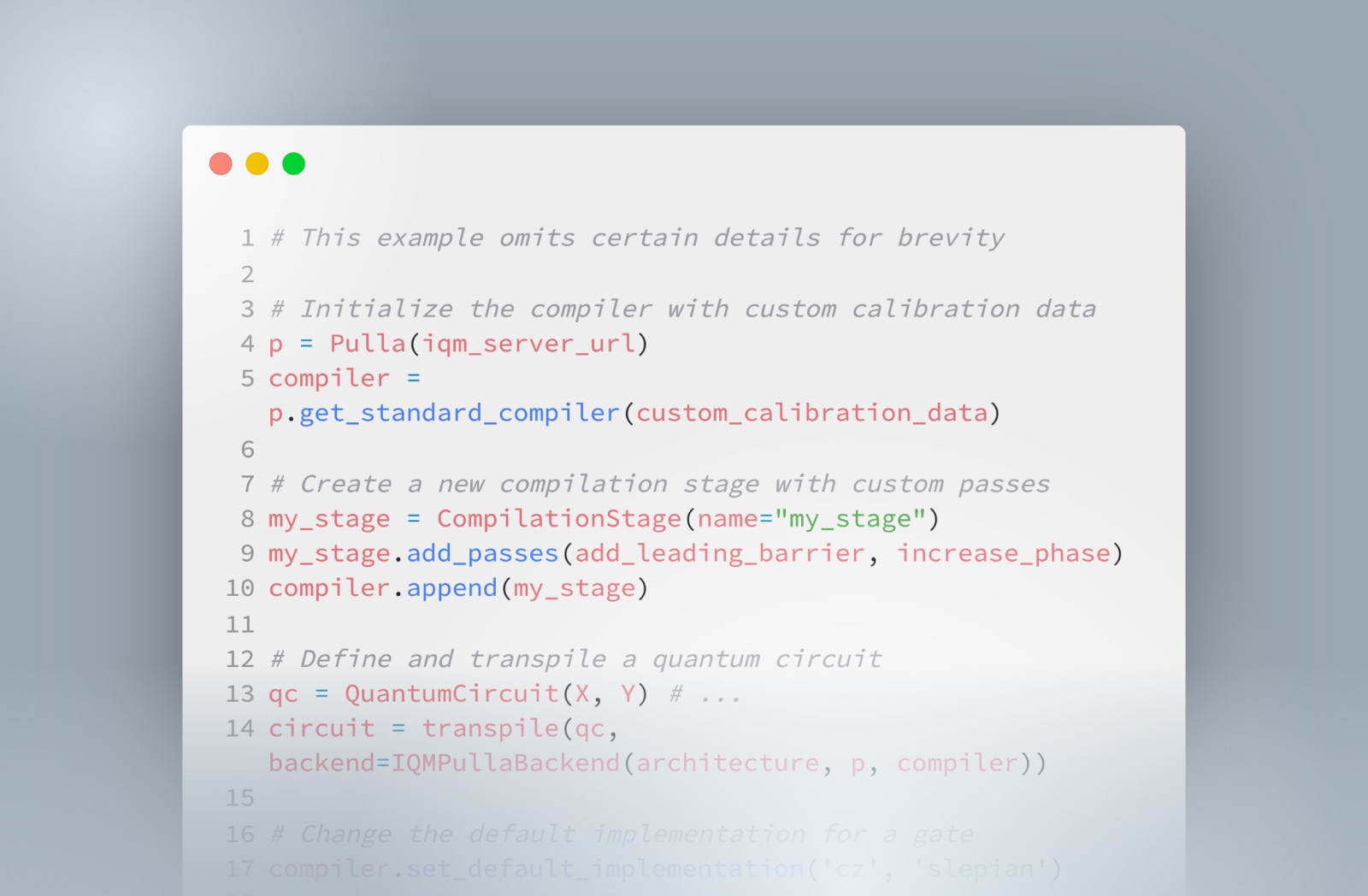
We offer full-blown compiler access. Pulla empowers users control the entire compilation pipeline. This is achieved via an unified quantum job compiler used across the entire IQM stack. This strategic upgrade brings together the best of our previous tools into a single, powerful engine.
The new compiler combines Pulla’s customizable, stage-based compilation with the sweeping and modding capabilities of IQM’s Experiment Automation framework. The compiler framework unification ensures consistency across the board: circuits submitted to the quantum computer are compiled with the new compiler ensuring that the entire software stack—from client-side development to hardware execution—is powered by the same robust compiler engine.
The key advantage of IQM Pulla is the visibility and ability to change the details of how a quantum circuit is compiled. With pulse-level access, end-users can:
To explore pulse-level access and see how IQM Pulla can transform your quantum workflow log on to Resonance, have a look at the IQM Pulla documentation.

Michael Sarpong Bruce is a Public Relations Manager at IQM Quantum Computers. He has over ten years of experience in marketing and communications across diverse industries, including mining, telecommunications, insurance and deeptech. He is also a former business journalist and has experience in public relations and media buying agencies.
Search faster—hit Enter instead of clicking.
Click to expand