
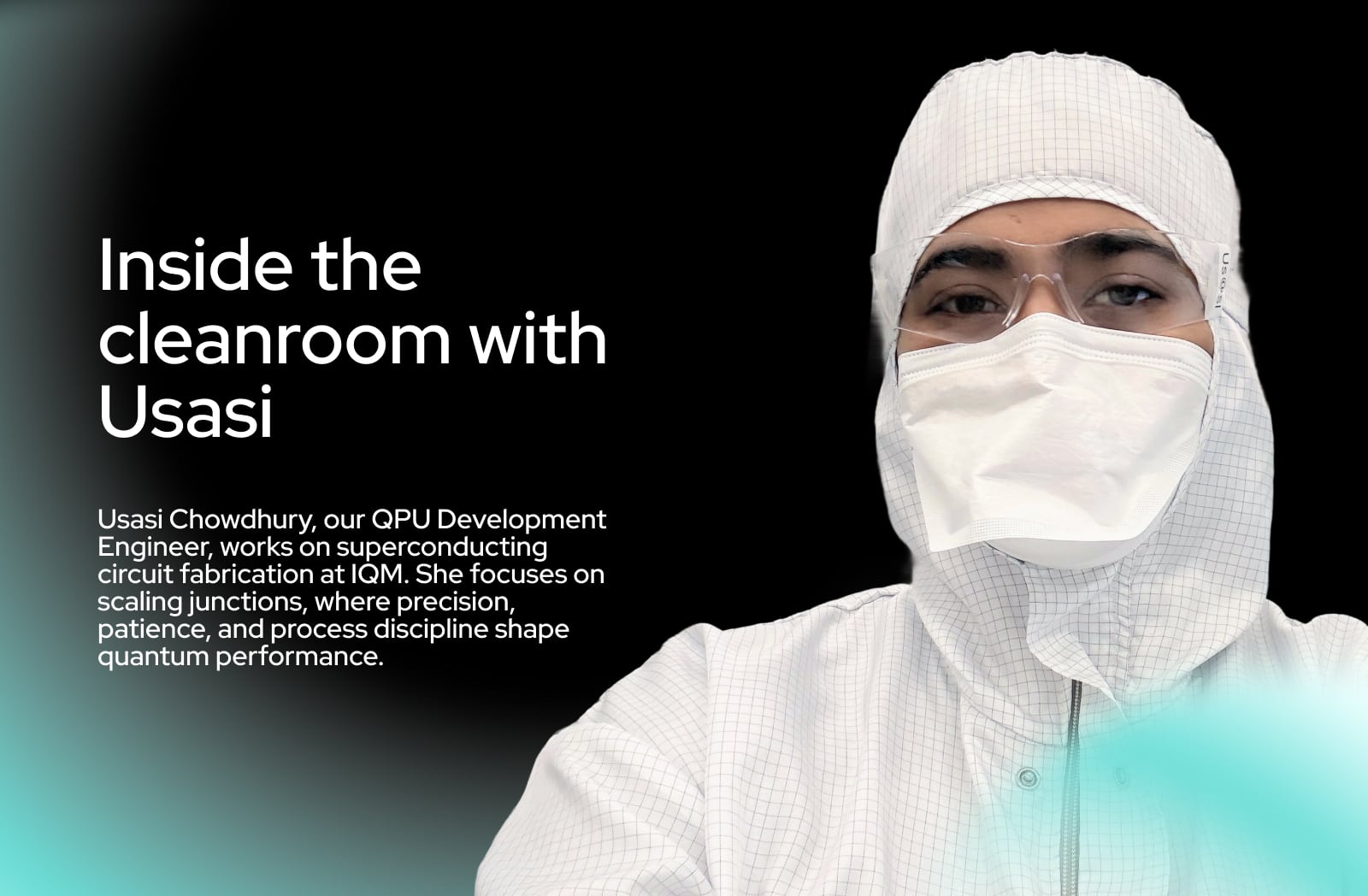
Inside the cleanroom, everything slows down. Movements are deliberate. Processes are precise.
It’s my peaceful place.
Fully suited up, following a process that can involve hundreds of steps: deposition, lithography, etching, more deposition. I work on something almost invisible. Superconducting junctions. Microscopic structures that determine whether a quantum system performs… or doesn’t.
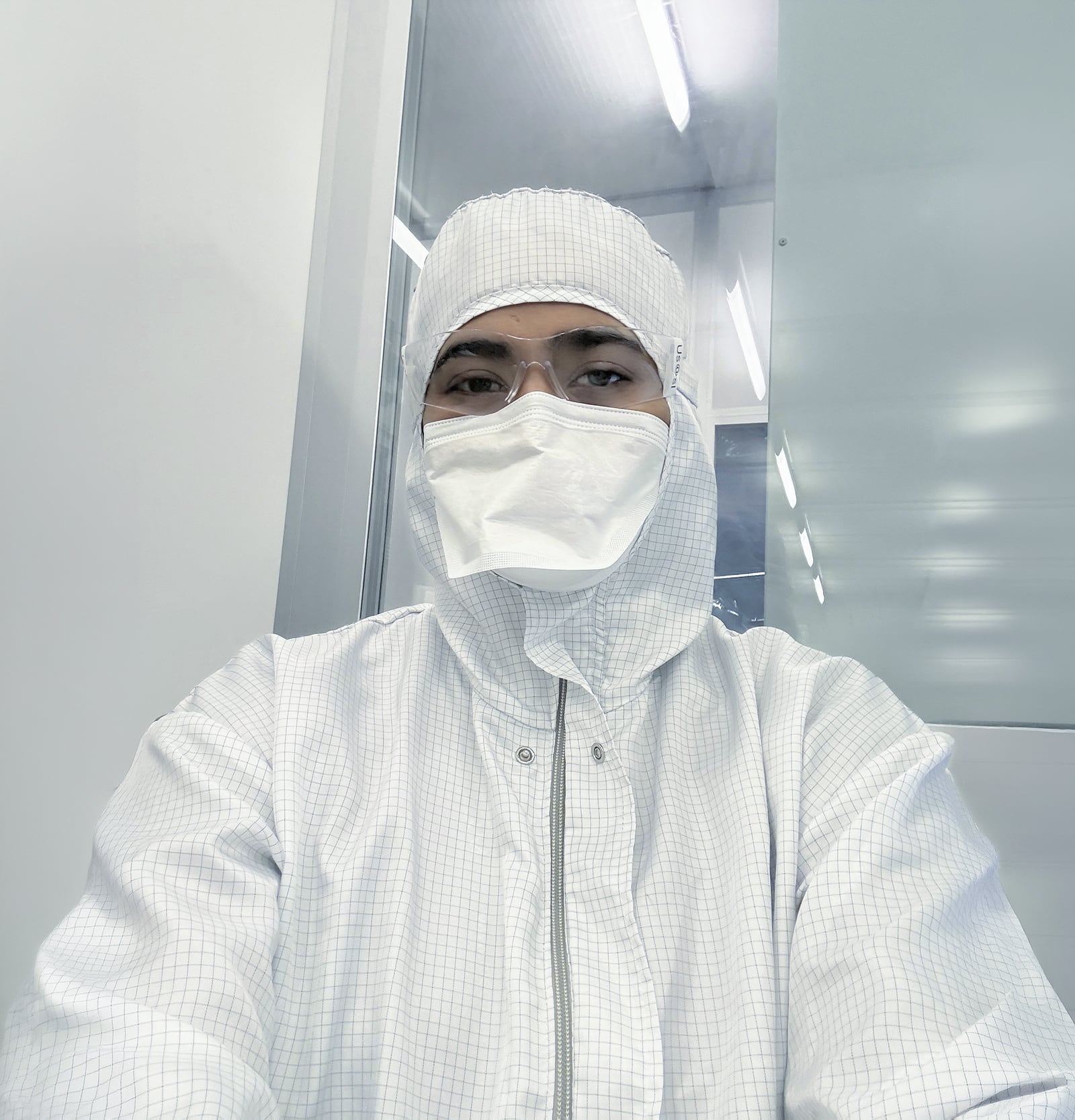
“If your mind isn’t calm, mistakes happen. So you slow down. You focus. You respect every step.”
When I’m inside the cleanroom, I feel centred. Almost like I become a different version of myself.
You see a big quantum computer, but its performance depends on something you’d barely see: the junctions. Without them, the system is decoration, just like a mobile phone without the chip. That’s what I work on – the heart of the system.
My role sits between research and production, where we develop processes that can later be used by the production team. It involves a lot of trial and error. Sometimes nothing works. And then something does, and that moment is worth everything.
I started with 1×1 cm chips, then moved to 2-inch wafers, 4-inch wafers, and now 8-inch wafers. With every increase in size, new problems appear.
Designing one circuit at research level can feel manageable. Making it work uniformly across an entire wafer at production level is a different challenge entirely. If junction variation and process stability aren’t controlled, performance shifts from chip to chip, and the system becomes unreliable.
We observe how the junctions behave across the wafer, how the chips vary, and what can be improved. That’s what keeps me in the cleanroom.
Moving from academia to industry wasn’t automatic for me. I had heard stories about difficult environments.
IQM feels different. Not a startup. Not a heavy corporation. There’s exploration, development, but also real industrial direction. That balance made the transition easier.
What surprised me most was the openness.
“People are serious about their work, but supportive. If you have something to say, you can say it.”
That transparency makes a difference. You can focus on your work and discuss things openly.
I’ve been here for four months and eighteen days – yes, I’m counting. But even in this short time, I can see how much is still taking shape.
Superconducting fabrication is still developing. There is space to build, to define processes, to shape how things will scale.
There’s also a human side to this place. Breakfasts, small events, moments to talk with colleagues outside the lab. It helps you feel like you belong, not just contribute.
Outside work, I talk a lot. I journal. I swim. I practise yoga. I cook Indian food inspired by the places I’ve lived.
In the cleanroom, everything becomes quiet. It requires focus and calmness, and I really enjoy that kind of work.
Having both feels right for me.