
Sourav Majumder lives by a piece of advice he once came across: go where you’ll be out of your depth. That mindset took him from India to Germany, from basic physics to the frontlines of quantum error correction.
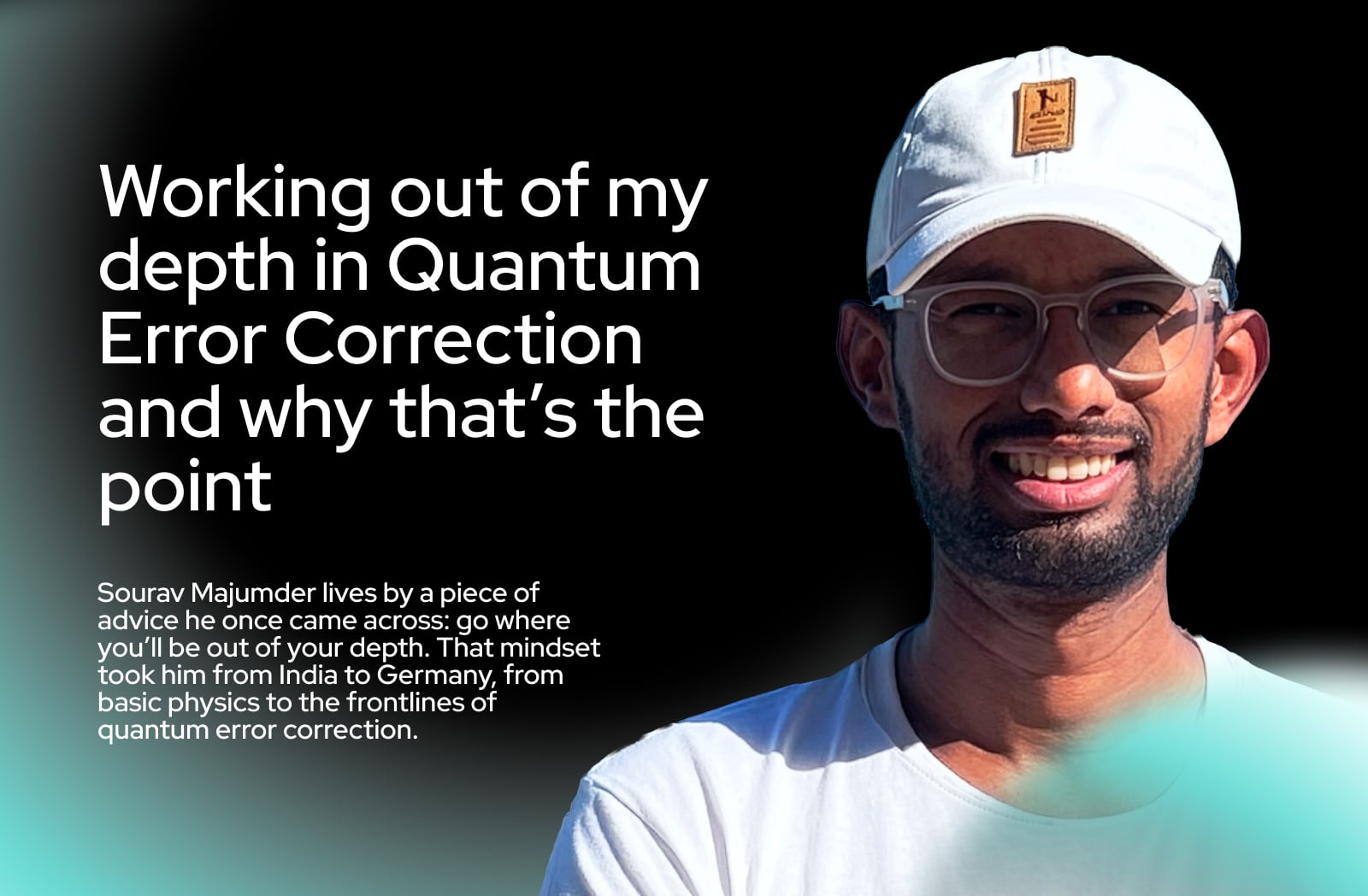
I once read a line by H. Jeff Kimble that stayed with me: “If you know what you’re doing, you shouldn’t do it.”
To me, it meant: go where you’ll learn. Go where you’re uncomfortable. That’s where growth happens.
I took that seriously. I did my PhD in physics in India. Then some IQM people visited my lab, I got curious, looked up the company, and a few months later, I moved to Munich.
I joined as a measurement engineer, calibrating quantum processors and preparing them to run circuits. It was solid, meaningful work, but QEC piqued my interest. One thing I learned: error correction is essential for realizing full-scale quantum processors. It felt like the natural next step.
So I started learning on my own. I began with classical error correction to build the foundations, then moved into quantum. Papers, talks, online courses, whatever I could find, I absorbed.
When IQM formed an experimental QEC team, I put myself forward. I didn’t have a formal title yet, but I had the curiosity, the physics background, and the hours of self-study. That trust changed the trajectory of my career.
People ask why I care so much about this. I tell them: a classical computer is a car. Fantastic on land. A quantum computer is a submarine; it opens up the entire ocean, problems that were completely inaccessible before. I first heard this analogy in a popular science video on YouTube, and it stuck with me because it captures the shift perfectly.
“The unknown is where the excitement lives. We don’t even know yet what all problems quantum computers will solve.”
Qubits are the basic units of quantum computation, and they are fragile by nature. They break constantly. Heat, electromagnetic noise, and tiny environmental disturbances knock them out of their intended states. Errors creep in during storage, during computation. Managing those errors is part of everyday quantum engineering.
Quantum computers are already useful today. In the Noisy Intermediate-Scale Quantum (NISQ) era, careful engineering, calibration, and error mitigation allow us to reach regimes that classical systems can’t.
Error correction is what removes the limits. It turns fragile systems into reliable ones and enables large-scale quantum computing. It requires more qubits, more resources, and larger processors. But that’s exactly why it’s built for scale. On small systems, you barely notice the impact. On large processors, it becomes essential.
As IQM scales up, QEC is what enables the transition from early quantum advantage to fault-tolerant machines. That’s how we reach the ocean.
During my PhD studies, I witnessed that QEC often stayed on whiteboards. We didn’t have access to large processors, so the majority of the work remained theoretical. I wanted more than theory. I wanted to see a scheme go from paper to silicon to actually correcting errors on a real chip. At IQM, that’s exactly what I get to do.
I could talk about flexibility, I get to choose my problems, set my hours. I could talk about trust; they let me join the QEC team before I was an expert. Both are true.
But honestly? It’s the people.
“People are the heartbeat of IQM. I’d find it hard to beat this team.”
When you’re stuck on hard problems, the team around you is everything. My colleagues make collaboration feel easy, even when the work is hard.
We have a theory team developing error correction protocols, and my experimental team is implementing them on real hardware. We maintain cross-team communication to enable rapid feedback. The steps in quantum computing are entangled together. You can’t separate them. And you can’t do them alone.
I’ve grown tremendously as a researcher here, building on the strong foundation from my PhD. While working in a small lab meant doing a bit of everything, IQM allows me to focus deeply on my niche, creating space to learn, mature, and go further.
IQM helped me relocate from India too, navigating German bureaucracy, finding housing, sorting permits. Now I spend weekends hiking around the Bavarian Alps, and evenings still reading about QEC.
Bigger processors are coming. More complex error correction schemes. The stuff that’s been theoretical for years, we’re going to run it on real machines.
We’ve got a road to cover. But that’s the point, isn’t it?
Search faster—hit Enter instead of clicking.
Click to expand